00 Original Venture
Wings & Prayers
An original venture: the story of The Little Blue Pilot, told as an aviation trivia game on Google Play, two children's records and fifteen illustrated chapters with twelve songs. Conceived, built, released and operated by WPAgency.xyz.
01 The position before
Wings & Prayers was operating in a position that didn't reflect the actual work.
The problem was one every studio faces: describing what it can do is not the same as showing it. Client work is bounded by a brief, a budget and a permission to publish. We wanted one piece of work that ran end to end, from a blank page to a thing people could hold, play and listen to, with every decision ours to make and ours to answer for. The constraint was the same one our clients live under: a two-person core, no outside funding, and a standard we had already promised in public.
02 The architectural move
What we built, and why this shape.
The strategic decision was to build a world rather than a product. The Little Blue Pilot is a character; Wings & Prayers is his journey. That one idea carries a storybook of fifteen illustrated chapters, twelve songs across two records, and an aviation trivia game, each made with the same identity and each pointing back to the others. Christy Anne wrote the story and the lyrics and directed the artwork. Arun Kumar built the game, mastered the records and put the infrastructure underneath all of it. The systems are the ones we propose to clients: a typed Flutter codebase for the game, a server-validated leaderboard, a static site for the story, and the distribution, measurement and search work that lets a small venture be found.
04 What changed
The position after.
The outcome is verifiable rather than reported: the game is live on Google Play, two records are released to streaming under The Little Blue Pilot, and the story has a home of its own at littlebluepilot.com, with the production notes documented at wpagencystudio.com. There are no download, revenue or audience figures here, because we do not publish numbers we cannot stand behind. What the venture proves is that the studio can originate an idea, carry it across story, music, software and distribution, and keep operating it after release.
06 The full story
Why a studio builds its own venture
Client partnerships and original ventures are sibling outputs of the same studio. A client engagement is proof of judgment inside someone else’s constraints. An original venture is proof of what the studio can originate when the constraints are its own. Wings & Prayers is the current one, and it is deliberately not a side project: it uses all four practices, it was released properly, and it is still being operated.
Building it also removes the usual asymmetry of a portfolio. There is no client to thank for the parts that worked and no NDA hiding the parts that were hard. The architecture below is the architecture we would propose for a comparable client build, because we made the same calls when our own name was on the line.
One character, three surfaces
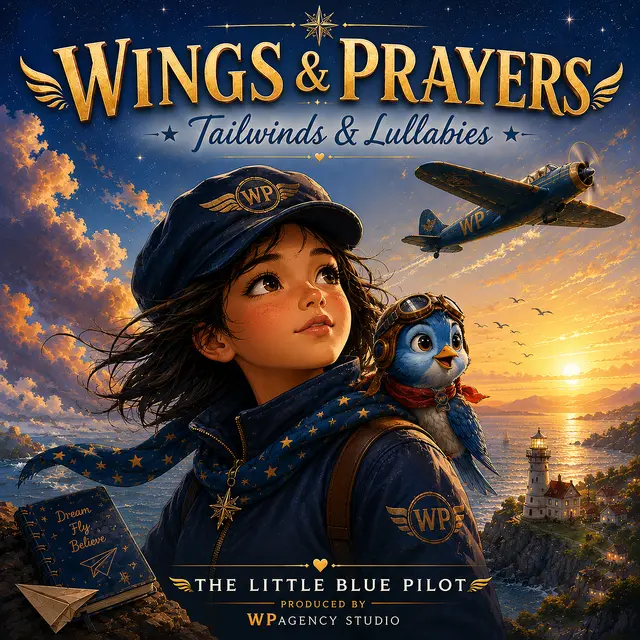
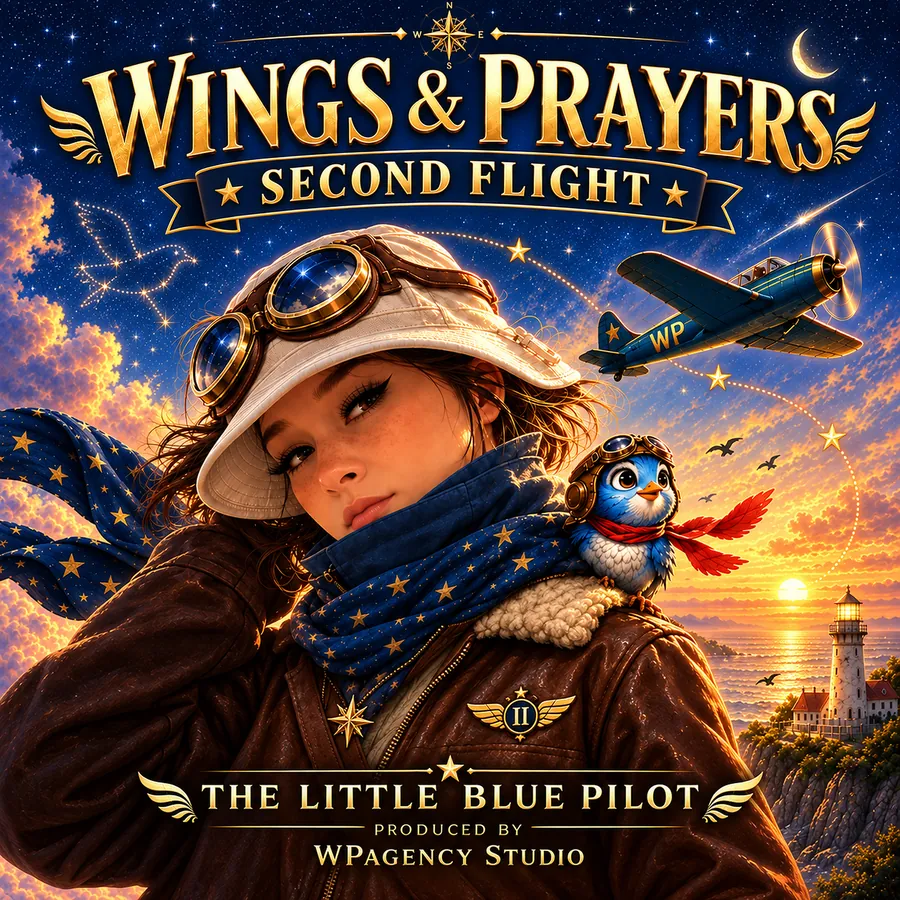
The venture began as a story. The Little Blue Pilot is a very small bird with a very big dream, and Wings & Prayers is his journey, told across fifteen illustrated chapters. The twelve songs came from the same writing, and became two records, Wings & Prayers and Wings & Prayers: Second Flight, released to streaming in 2026 under The Little Blue Pilot. The game is the third surface: an aviation trivia game with the same identity, where the milestone tiers, the logbook and the ranks carry the story’s language into play.
Two records of the same twelve songs
Wings & Prayers was released on 11 August 2026. Wings & Prayers: Second Flight followed on 11 September 2026: the same twelve songs in the same order, performed again for the storybook films rather than remastered from the first record. The first record is unchanged and still out. The second is another route through the same material, and the eight songs of the album proper are also told as one continuous film in eight chapters.
Both records were mastered in house with the studio’s own audio engine, and the targets and measurements behind them are published rather than described. That is the standard we hold client work to, applied to our own release.
The three surfaces point at each other. The story lives at littlebluepilot.com, the records are distributed to the stores, and the game is on Google Play. The production notes, from mastering targets to the analysis behind them, are documented on WPAgency Studio, where the studio publishes its original work as it is built.
Who did what
WPAgency.xyz is a two-person core, and this venture shows how that works in practice. Christy Anne wrote the story and the lyrics, directed the artwork, and set the creative direction that ties the chapters, the covers and the game together. Arun Kumar built the game, mastered the two records, and built and operates the sites, the distribution and the measurement underneath them. Nothing was outsourced that we would ask a client to trust us with.
The game: one codebase for two platforms
The central engineering decision was cross-platform from day one. We wanted the game logic, the scoring, the streak system, the milestone maths and the lifeline rules written exactly once, so the game is built in Flutter: a single typed codebase compiled to native, with platform feel preserved where players notice and shared everywhere they do not. It is live on Google Play; the iOS build comes from the same codebase and is not yet in the App Store.
That is a deliberate trade, not a hedge against learning two native stacks. When one small team is shipping the same product to both platforms and the value is in the game system rather than deep per-platform hardware work, a single Flutter codebase is the correct call. We have written up the honest version of that trade-off in our Flutter versus native breakdown, and Wings & Prayers is us taking our own advice.
Predictable game state
A trivia run sounds simple until you write it down. At any moment the app is tracking the active streak, three kinds of lifeline with independent counts, the current milestone tier, a bank that grows as you clear tiers, a daily multiplier that is consumed on takeoff, and a strike count that ends the run at three. All of that has to stay consistent across screens, survive backgrounding, and resolve cleanly if the player force-quits mid-flight.
State is managed with Riverpod. Each concern lives in a well-scoped provider, and the interface is rendered as a function of that state rather than mutating widgets directly. The practical payoff is that there is no ambiguous in-between: a run is either in progress with a defined state or it is not. Force-quitting to dodge a third strike does not leave a corrupted session, because the daily anchor is consumed at takeoff and the state machine has no undefined branch to fall into. Predictable state is what lets a game like this be fair.
Navigation and a leaderboard you can trust
The app has more navigation than a trivia game first appears to need: the wheel, the run, the milestone screens, the logbook, the career dossier, the leaderboard, the hangar, and the legal and account surfaces. All of it is routed with GoRouter, a declarative route table instead of a sprawl of imperative calls, so deep links resolve correctly from outside the app and the back stack behaves identically on both platforms.
A global leaderboard is only worth shipping if scores cannot be faked. The competitive surface is built on Firebase, with optional sign-in and a top-100 of auto-generated callsigns. Scores are server-validated rather than taken at the client’s word, which means the lifetime score and pilot rank that feed the leaderboard have to be earned through the same validated path. The daily multiplier, the milestone bonuses and the strike ceiling all live in logic we control.
Shipping through review
The last mile of a product is the part the architecture diagrams leave out. Getting the game live on Google Play meant satisfying a real review process: an account-deletion flow, privacy and terms surfaces, store metadata and offline behaviour. We treat that as engineering, not paperwork. Those surfaces were built into the product because the store requires them and because they are the right thing to ship anyway, and the same build is what will go through App Store review.
The logbook as story
The game carries a logbook of thirty achievements across eleven tracks, from Cleared for Takeoff to Against the Odds. Each unlock has badge art, a rarity tier, and a short line from the flight recorder: a quiet verdict on what that achievement means. First Wings: “It does not crown you. It just says: you are airborne now.” Wind Reader: “A good pilot does not curse the gust. They trim for it.” These are not decoration. They are the story of learning to fly, told through play, and they are the reason the game and the storybook feel like one thing.
What this proves, and what it does not
We will not invent numbers for our own venture. There are no download counts, streaming figures, revenue or testimonials here, because honesty is a positioning asset and fabricated metrics would corrode the one thing this page exists to demonstrate.
What it does prove is concrete: the studio can originate an idea and carry it across story, music, software and distribution; it ships a native-quality app from one codebase; it wires a backend so the trustworthy parts are actually trustworthy; and it keeps operating what it releases. If you want that range pointed at your own business, that is the conversation to have: request a partnership review.
· In their words
"We build our own ventures on the exact standard we sell. Wings & Prayers exists so we can point at finished work instead of describing it: a story, two records, a shipped game and the systems underneath, all of it ours."
· Work with us
Have a system that deserves this kind of work?
We take on a small number of new partnerships each year. Tell us what you're building and we'll respond within one business day.
Start a conversation →