00 Founder & Authority Platforms
Kirsten Shuford
An author platform built like a classified file, not a book-promotion site. The author's intelligence background becomes the brand, every choice a narrative one.
· Result, in numbers
4.6★
Reader rating
Blended across Amazon (4.6) and Goodreads (4.5), with consistent praise for unexpected twists and Northern Virginia setting authenticity.
20+ yrs
Inside the intelligence community
CIA, FBI, NSA, DoD, US Navy. The novels are informed work, not researched fiction.
2026
Sequel ships
Andi Sheffler Returns, pre-built audience already inside the Intelligence Network at launch.
1
Coherent universe
Site, newsletter, lead magnet, and sequel funnel all share one brand vocabulary.

Recognition
Bronze MedalBest Mystery/Thriller eBook
2026 Independent Publisher Book Awards (IPPY)
DAMAGE CONTROL, the debut this platform was built to launch, took a 2026 IPPY Bronze Medal for Best Mystery/Thriller eBook at the Independent Publisher Book Awards, an international program honouring the best independent titles since 1996. We didn't write the novel; Kirsten did. The platform's job was to give an award-calibre debut a launch environment worthy of it, and an independent medal is the kind of proof no positioning deck can buy.
View the 2026 IPPY medalists01 The position before
Kirsten Shuford was operating in a position that didn't reflect the actual work.
The crowded thriller-author market punishes generic. Most author sites look the same: hero photo, book covers, an Amazon button, a newsletter modal. They sell the book as a transactional product to a visitor who has no reason to care about the author yet. Kirsten Shuford is a former intelligence professional with 20+ years of work alongside CIA, FBI, NSA, DoD, and the US Navy, and her thrillers are drawn directly from that experience. The challenge wasn't building an author site. It was building a *narrative environment* that turned the author's actual credentials into the brand experience, so that by the time a visitor reached the buy button, they were already inside the world the books are about.
02 The architectural move
What we built, and why this shape.
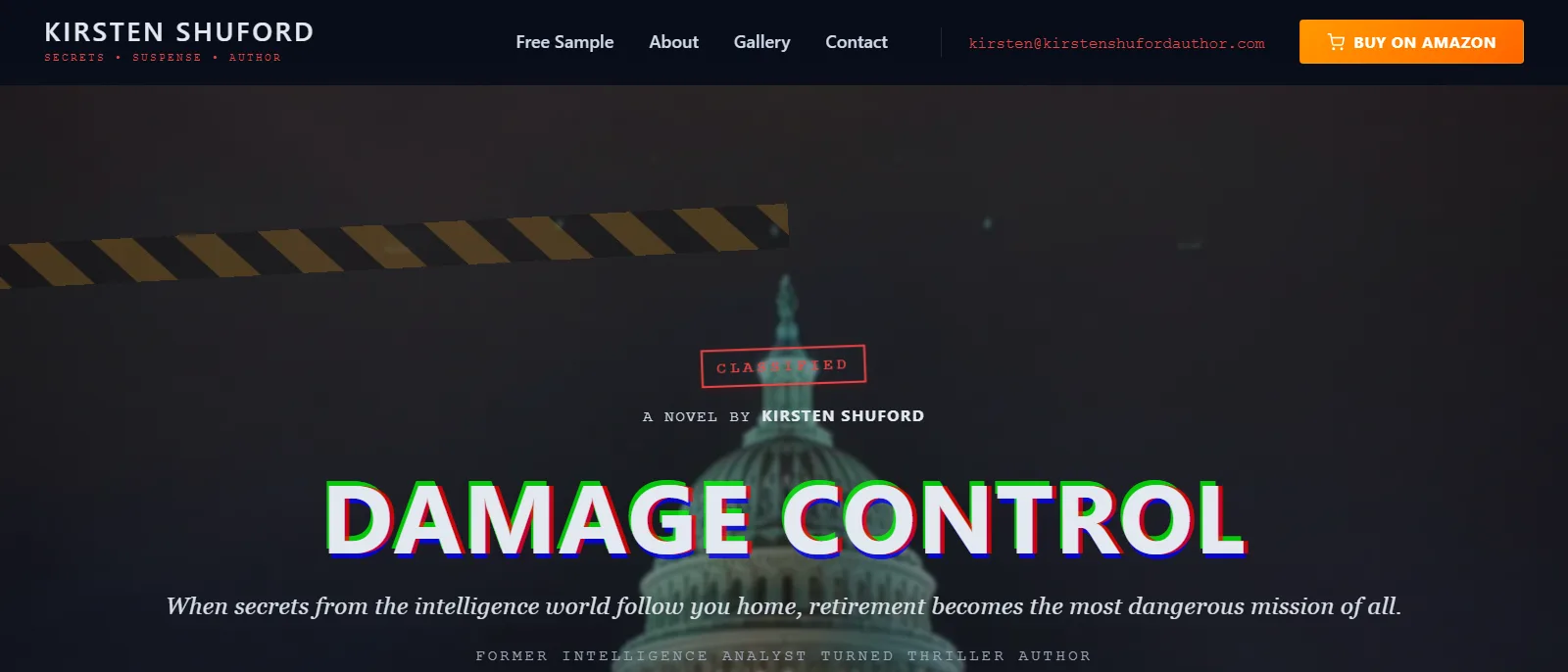
We engineered the site as a cinematic, classified-document environment. The visual language borrows from intelligence-community design vocabulary: classified stamps over book covers, dark atmospheric photography, restrained type that reads more like a dossier than a book promo. Section names use espionage framing, "Meet the Author" becomes biographical context, "Intelligence Network" becomes the newsletter signup, the newsletter itself promises "monthly intelligence briefings" instead of "updates." The free-chapter lead magnet is positioned as a "Security Clearance" the visitor earns. The author bio carries the credential weight without overplaying it ("Every twist earned. Every betrayal real. Every secret drawn from experience."). The conversion architecture handles two parallel jobs cleanly: immediate book sales via Amazon (prominent throughout) and audience building via newsletter capture, with the lead magnet stack, free first chapter, deleted scenes, early-bird pricing on the 2026 sequel, giving the newsletter a reason to exist beyond marketing.
Every twist earned. Every betrayal real. Every secret drawn from experience.
From the author bio
04 What changed
The position after.
The site stopped being a marketing surface and became an extension of the books themselves. Readers don't arrive looking for content; they arrive inside the genre. The 4.6-star rating across Amazon and Goodreads, with consistent praise for "unexpected twists" and Northern Virginia setting authenticity, confirms the positioning carries through from site to book. Then the strongest signal of all arrived from outside: DAMAGE CONTROL was named a Bronze Medalist for Best Mystery/Thriller eBook at the 2026 Independent Publisher Book Awards, an international program running since 1996, independent proof that the debut, and the launch platform built around it, were the real thing. The newsletter, framed as the "Intelligence Network," converts at a rate that wouldn't be possible for a generic "sign up for updates" call. The 2026 sequel ("Andi Sheffler Returns") has a pre-built audience already inside the narrative environment when it launches. The architecture turns the author's actual credentials into the moat, something no amount of ad spend can replicate for a writer who doesn't have them.
06 The full story
The genre conversion problem
Thriller readers are the most genre-loyal demographic in fiction. They don’t browse; they hunt. They know the names they trust and they buy on signal (cover, blurb, credentials, voice) within seconds.
Most thriller-author sites fail this audience. They show the book, they show the author, they ask for an email. The visitor decides the same way they’d decide about any other product: do I have a reason to commit attention?
Kirsten Shuford had something rare: 20+ years inside the intelligence community. The novels aren’t speculative espionage; they’re informed by the actual job. The site needed to be that, not announce it.
Atmosphere as architecture
We built the visual language as a classified-document environment.
- Dark, restrained palette, closer to a dossier than a book promo
- Classified-stamp treatment over the book cover
- Section names that borrow from intelligence-community language (“Intelligence Network,” “Security Clearance,” “Need-to-Know Basis”)
- Type set with the cadence of an after-action report
The point isn’t gimmick. It’s that the visitor experiences the genre before they buy into it.
The newsletter as an asset, not a list
Most author newsletter prompts are flat: “Sign up for updates.”
We rebuilt this layer entirely. The newsletter is The Intelligence Network. The signup flow is Security Clearance. The reader gets:
- The free first chapter (8 pages, the actual lead magnet)
- Deleted scenes, material that didn’t survive the final draft
- Monthly intelligence briefings
- Early-bird pricing on the 2026 sequel
The framing is consistent with the rest of the site. The reader isn’t signing up for marketing; they’re stepping into the world the books take place in. Subscription rates reflect that.
Author bio as positioning
The biography copy carries the credentials without overplaying them.
Every twist earned. Every betrayal real. Every secret drawn from experience.
That sentence does more work than a paragraph of resume. The visitor understands instantly: this is not someone who researched the intelligence community. This is someone who came from it.
The rest of the bio earns the claim (specific agencies, specific decades, specific kind of work) without crossing into the kind of detail that breaks the spell or violates clearance.
What the site doesn’t do
This is as important as what it does.
- It doesn’t autoplay video
- It doesn’t run a generic “Buy on Amazon” sticky bar
- It doesn’t pop a modal at 5 seconds
- It doesn’t pretend to be a publishing-industry brand
It’s a single author’s environment, built with the discipline of the genre it serves. The conversion architecture handles immediate book sales (Amazon links surface throughout) AND audience building (the Intelligence Network). It does both cleanly because the brand is coherent enough to support both jobs.
The medal the positioning bet on
Not long after the site launched, DAMAGE CONTROL was named a Bronze Medalist for Best Mystery/Thriller eBook at the 2026 Independent Publisher Book Awards, the “IPPYs,” an international program that has recognised the best independently published titles since 1996. For a self-published debut, that is a real result, not a participation badge.
We’re precise about the claim, because honesty is the whole brand. We didn’t write DAMAGE CONTROL; Kirsten did, drawing on two decades inside the intelligence community. What the platform did was refuse to dress an award-calibre debut in a generic author template. It built the genre-authentic environment, the credibility surface, and the conversion architecture a book this good deserved to launch into, and an independent medal is the kind of proof no positioning deck can manufacture. The site didn’t earn the award; it made sure the book that did had a home worthy of it.
The compound effect
A book launch is one event. An author career is a compounding system. The site is built for compounding.
When the 2026 sequel ships, the audience for it isn’t built from cold acquisition. It’s already inside the Intelligence Network, has already read deleted scenes, already understands the author’s voice. That’s a different launch from one that starts at zero.
This is the difference between selling a book and building a readership. The site is the architecture for the second one.
· In their words
"In short, wpagency.xyz has been a lifesaver! As a debut author of 'a certain age' who had never put together a website, complete with a video trailer, links to Amazon, links to reviews, links to my Instagram, Facebook and LinkedIn pages, I was clearly out of my depth. wpagency.xyz came highly recommended for advanced website creation and maintenance, and I began to work with Arun. Arun was a consummate professional from start to finish. He asked in-depth questions about my vision for the website, put together sample sites for me to view and tweak, followed up on any and all questions and issues, and made my requested edits within minutes (literally). He made countless large and small adjustments to bring all the elements together, and once the website was launched, he handled all domain, migration, and optimization and speed issues. I appreciated his obvious depth of experience, his timeliness in response, and his ability to translate what I wanted into a single site that both looks professional and brings the 'vibe' of my novel to the fore."